Leash reactivity — what you see, and what is actually happening
A dog that lunges and barks at other dogs on the street is not necessarily aggressive. Often, they are afraid — and trapped.
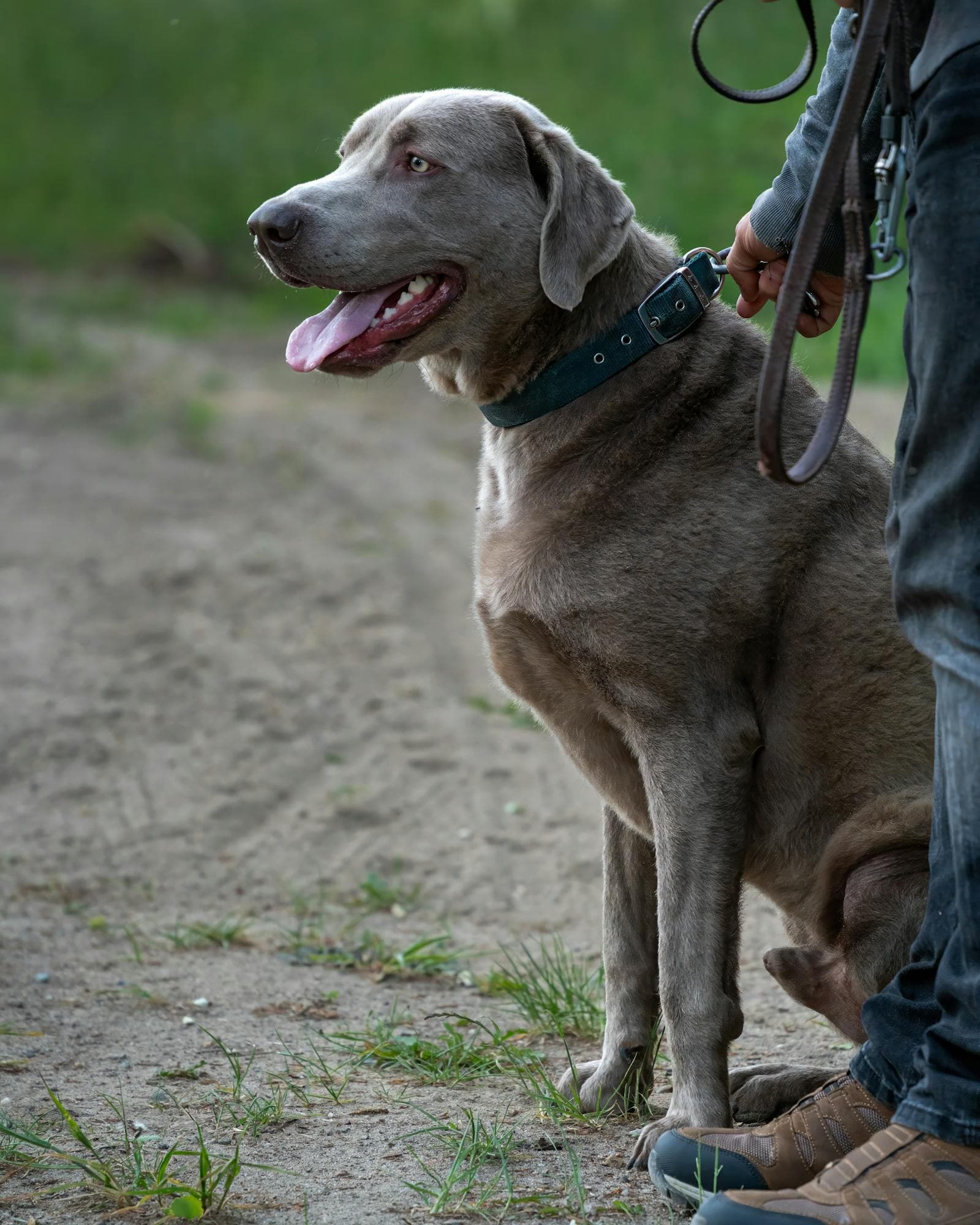
Invitation to the street: a dog, a leash, an owner. Another dog appears around the corner. Your dog lunges, barks, tries to bite the leash. The owner gets pulled, others watch, there is shame.
Most of this story is not about aggression at all.
The leash is the context
A free dog in a park meeting another dog knows exactly what to do. They can approach at an angle, sniff the back, swerve, drift, leave. Their social tools are available.
The same dog on a leash has lost their two most important tools: the ability to approach at an angle, and the ability to leave. In front of them stands another dog, and their choices are reduced to two — freeze, or act. Apparent aggression is, very often, the dog trying to make the threat go away, from the narrow place they're in.
What they are trying to say
- "I don't like this. Move it away from me."
- "I don't know what to do. Let me out."
- "I'm afraid, and I am louder than I really am."
They almost never say "I want to kill that dog."
What not to do
- Sharp leash pop — confirms to the dog that the connection between you in this situation is tension. Makes the next encounter even more loaded.
- Direct approach toward the other dog — equivalent to face-to-face confrontation in the canine world. This approach is not friendly.
- Hiding behind your body — confusing. The dog senses you are also worried, which confirms there is reason to worry.
- Pushing into the situation "to get used to it" — flooding is not learning. Flooding is trauma.
Our approach
We work on threshold. We find the distance at which the dog notices the other dog but has not yet reacted. At that distance, we build a different routine: cue, treat, drift, treat. Again and again, in dozens of controlled encounters.
That distance shortens over time. And no — not in two weeks. A good process for leash reactivity takes between eight and fourteen weeks, depending on the dog's history, your precision, and the number of situations we can design well.
The early promise
Almost every dog that arrives with high leash reactivity leaves on entirely different walks. Not because we "broke" them — because we taught them that they can be safe even with the leash on. When safety returned to their body, the need to shout it disappeared.
The first step is a quiet conversation.
Tell us about your dog. We'll design a path from where you are now to where the two of you can be.